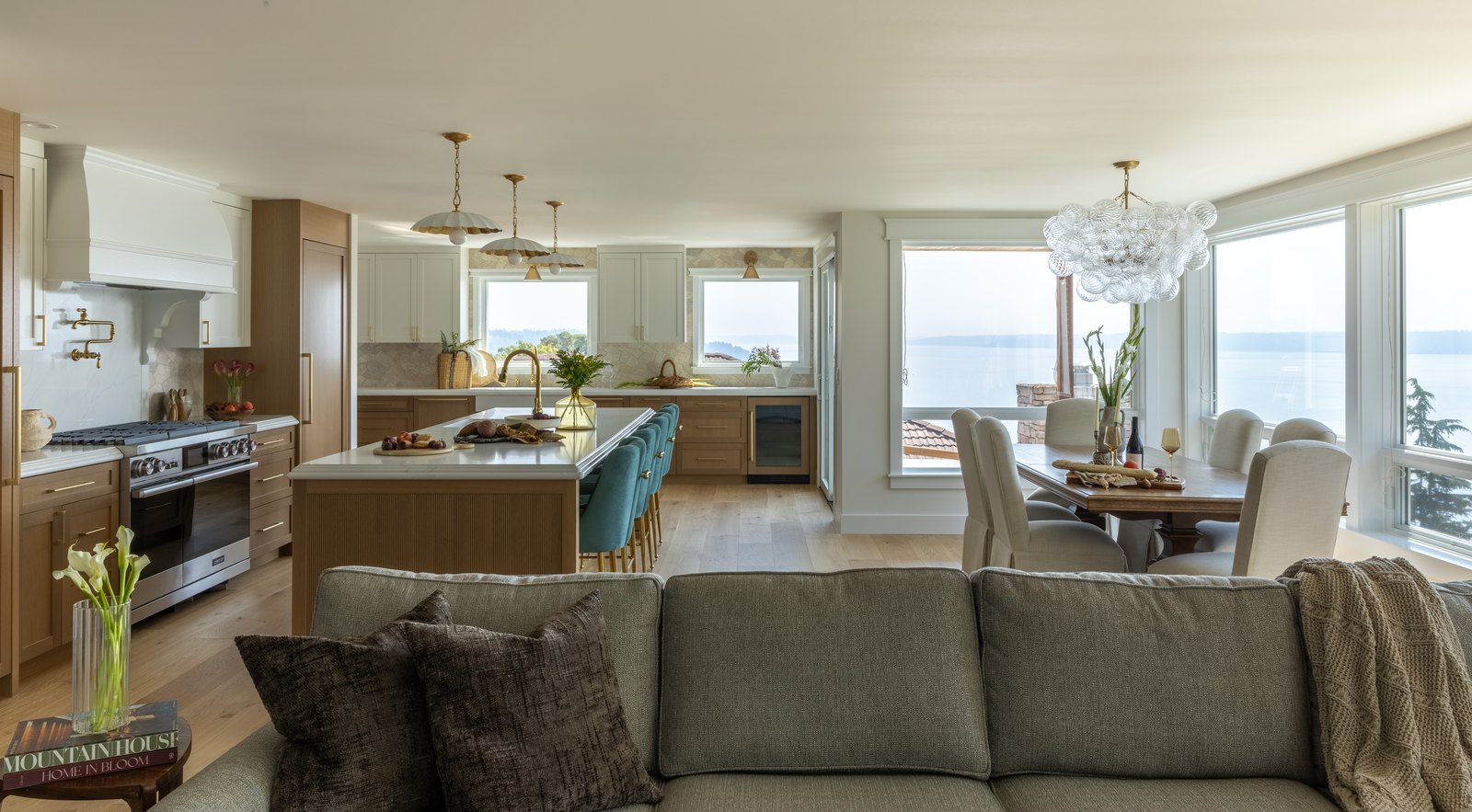
Quick confession before we dive in: I used AI to help write this post.
Did I have it write the whole thing? Absolutely not. Every word here is mine. I just handed it over at the end to catch my typos and wrangle my run-on sentences, of which there are many. Which, funnily enough, is more or less the entire point I'm about to make.
I've been circling this topic for months. It's a touchy one right now, and I understand why. But I also think it's a little silly to pretend a tool isn't sitting right there on the table.
So, the questions we get constantly: do we use AI? How? Are we nervous about our jobs? Yes, we use it. Happily. But we bring it in after the real work is underway, never before. It's an assist. It's a finishing layer. It is not the thing that makes the thing.
The part that still belongs to us
Here's what I keep coming back to. Design was never really about pretty pictures. It's about the way someone drifts through their kitchen at six in the morning before anyone else is up. It's where the afternoon light lands in October. It's whether the backpacks get dumped in the entry or the mudroom, and whether anyone will actually walk the extra ten feet to do it. It's a client telling me they want a wide-open kitchen when what they really mean is they'd rather not be watched while they cook.
None of that fits in a prompt. It comes out of a conversation, a walkthrough, a few nosy questions, and an enormous amount of listening. That's the part of this work I'd defend with my whole chest, and it's the part I worry about when someone hands their entire project to a chatbot and calls it done.
And here's the thing I find quietly hopeful: the more polished and automated everything gets, the more people seem to ache for the opposite. The hand-thrown bowl. The imperfect plaster. The room that could only belong to one family. Design is drifting back toward warmth and toward the human fingerprint, and I don't think that's a coincidence. I think we're all a little tired of perfect.
If you're using ChatGPT to dream up your space, please do. It's fun. But talk to a designer too, if it's in your budget. I know it isn't always, and AI genuinely helps people taking on smaller projects. It has a seat at the table. It just isn't going to plan your house around the life you actually live, and it will never look at your existing structure and tell you the truth about what your money will buy.
The images clients bring me
I get AI images from clients constantly, and honestly? I love it. Someone sends me five renderings and within thirty seconds I understand their taste better than I would after an hour of adjectives. It's a shortcut straight to the feeling, and that's a gift.
The flip side is that when there's no real basis of design underneath it, AI makes everything look more or less the same. Once you notice it, you can't unsee it. The same finishes. The same proportions. The same soft, flattering glow on every surface. It'll tell me whether you lean light or dark, modern or classic, and that's genuinely useful. But it misreads budgets all the time, and it has a real talent for making things far more complicated than they need to be.
So after I've absorbed the feeling, I tend to leave it at the door.
Because the moment we start walking the actual house, the design shifts. I'd say ninety percent of the time it shifts significantly. We talk money. We talk about what's structurally possible inside that number. We talk about what's actually available here, and what it costs here. The image was never a plan. It was a mood. And a mood is a beautiful place to begin and a terrible place to build from.
A word about renderings
We do run AI over our renderings. It adds a realism clients adore, and it helps people genuinely picture themselves in a room instead of squinting at a gray box.
But we have to get that rendering about ninety percent of the way there first. Otherwise it develops opinions. You'll get strange scale, details nobody asked for, little flourishes invented out of thin air. And here's my favorite quirk: the more times you ask it to revise, the more it quietly redecorates behind your back. A window slides. A cabinet puts on weight. Something you never touched looks subtly, maddeningly different.
So we've learned to push our renderings further along before AI ever lays eyes on them, so it only needs one pass. Give it less room to improvise and it behaves beautifully.
You can usually still tell. It's very good. It is not perfect.
The apps that promise to price your remodel
There's a whole crop of apps right now promising they'll read your room, price your room, and hand you a tidy estimate. We've tried plenty of them, because of course we have. At thirty thousand feet, there's something there. You'll get a ballpark.
But down in the weeds, where projects actually live and breathe, it comes apart. Every state is different. Every jurisdiction is different. Every contractor is different. No app on earth holds all of that.
We had a client arrive with a number AI had given them, feeling very good about it. What it missed: Washington State energy code, which is not optional and is not cheap. It also didn't realize the cabinets it had designed weren't standard sizes, so they'd have to be custom. And it couldn't possibly know there was HVAC running through the wall, which meant the plumbing had to move.
Their project got dramatically more expensive over the course of one afternoon. That's not a conversation anyone enjoys having.
Where it's earned its keep on the architecture side
One of the genuinely hardest parts of my job is keeping up with code. In Washington, requirements swing wildly from one jurisdiction to the next, and then you stack state requirements and the International Building Code on top of that. Keeping every change straight is a full-time job nobody's hired for.
So AI has quietly become part of our QC. We run a first pass on drawings before anything goes out to a client or a city, and it's excellent at explaining code sections. That's been a real relief.
But it isn't drawing anything. It doesn't know local conditions beyond what's printed on the page. It can't walk a site and catch the thing you only notice standing in the room with your head tilted. And it certainly can't be the person holding the line between the client, the designer, the engineer, and the city.
I'd genuinely love to see jurisdictions use AI to move through initial plan review faster. But a human has to stay in it, because no two conditions are ever truly the same, and that is precisely the thing AI is worst at noticing.
So, my honest advice
Take it with a grain of salt. Use it to find your style, to get excited, to finally show someone the thing that's been living in your head. That part is wonderful.
And then bring it to someone who can stand in the room with you. AI is a very good tool. It's at its best when there's a person behind it who knows the house, knows the budget, and knows the people who'll be living there long after the renderings are forgotten.